
Rick McBee's Writings
Explore the magic of new ideas and books to read as well as see what books I have written, my favorite photos, my opinions on may subjects, including Science, Africa, the Caribbean, the Civil War, my Book Reviews, and Much More!
Reader Questions for “Rough Enough” #4: What was it like starting off in the Army – then and now?

Richard Clow’s first enlistment at age 17 was a one hundred day gig at Camp Meigs in Readville, Mass. which began on August 18, 1864. This sounds somewhat like the Reserves training of the 1960’s to me; the volunteer receiving three months of indoctrination and training with the 22nd Massachusetts Infantry followed by having the option of either extending and going on active duty, or of going home and waiting to be called in case there was a real crisis.
As you read through chapter 2, think about each of these following questions and write your own opinions as they may differ from my own interpretations of Richard Clow’s words.
1. What does Richard’s first letter say to you as you read it in the opening words of Chapter 2 and look between the lines to figure out how he is getting along? Is he enjoying the training, company, and life int the barracks?
2. What does it say about the training and life in the barracks for the first three weeks to know that he has already worn out his boot and doesn’t have enough warm blankets, a vest or a mattress to sleep on?
3. When we think of “winning” a war, it can have several different meanings as to the actual outcome depending on which side you belong to. What do you see as the real hope of the South in fighting this war? Do they want to be totally free of the North? What terms of agreement would the South want if they were negotiating a truce and how would these terms differ from those desired by the North? What does winning a total victory mean for the South and what does it mean for the North?
Why Richard Headley Clow is my Favorite Civil War Personality
My favorite personality for the Civil War is a private named Richard Headley Clow who was at the front lines of Petersburg from Feb. 1865 through April, 1865 and then went on to Appomattox.
My reasons for this are the following: 1. Richard Clow wrote a series of thirteen letters to his sister Agnes Clow who was in Boston, while he was in training, at his embarkation, and while going on patrols and assalting the bastion of defences around Petersburg, VA. Thus I can read his actual words and understand how a young seventeen year old boy decided to enlist and how he learned the hazardous ropes of the game of war while pulling picket duty and sneaking around Confederate defenses on the front lines. 2. I am still, after six years of work on my book, “Rough Enough” amazed that a seventeen year old would have the audacity to fill out his enlistment papers with the direct lies of age: nineteen (it was actually seventeen), residence: Rhode Island (he was actually born in Nova Scotia, Canada and at the time of his enlistment resided with his older sister, Agnes, in Boston, and inreality was running away from a rather posh life that he had lived into the depths of the dregs of humanity at war. 3. I have always been intrigued by his references in his letters to the girl he left behind, Reina, who disappears into the mists of history. 4. I love the way Richard describes some of the minute details of his surroundings, to include the facts of berry picking, the flocks of ducks, the sunken hulks in the James River and the meeting up with his brother at the Grand Review after the war.
As if these were not enough, I am intrigued by the personality of a young man, who, having been through terrifying experiences in battle, returns home briefly and then reenlists to join the 13th infantry on the frontiers of Montana and the Dakotas to fight Indians. His letter and brief diary make it apparent that he endured immense hardships, was able to triumph over these and the deaths of friends and family members to go on to become a successful gold miner and dairy farmer in Deadwood, S.D. and then once again take off on the “wild goose chase” with his young wife and children to sheep ranch in Idaho, gold mine, farm and run a hotel in Oregon, and eventually die of old age in Eugene, Oregon.
Richard Clow’s personality through history is a guiding light to me as I pursue my own “wild goose chase around the planet.
Reader Questions for “Rough Enough” #3: The Media Discrepancy and the Civil War Reality: Do a “Googlelup”
As you are reading through chapter 1 of Rough Enough, take a bit of time to “googlelup” (is that a new word?) some of the old periodicals and newspapers that have been scanned into the internet. I would suggest Harper’s Magazine and Frank Leslie’s Illustrated Newspaper as starters. Read a couple of the descriptions of the battles that took place during the spring of June 1864. Again, a good one is to look up about the Battle of the Crater at Petersburg. Take a bit of time to read the verbiage and of the papers and then if you haven’t already read it, get a copy of The Crater, by Richard Slotkin (There are others who have also written on this theme including Newt Gingrich etc., but Slotkin’s work is the definitive piece.)
Once you have read the correspondents’ newspaper articles and seen those same battles described by historians with more access to the “facts”, you will begin to get the picture of why Richard Clow and others were lured towards the all consuming fires of the war’s front lines.
Now look at the pictures drawn by artists who may or may not have been anywhere near the war’s front lines. If you don’t have any pictures, take a good look at the cover of “Rough Enough” itself! The message is the same, an idealized view that sends a message very unlike the true reality of war.
After doing this, compare these idealized pictures with the photographs from the battlefield in the national archives. The rotting corpses in the ditches, the shattered houses and buildings and exhausted soldiers.
Once you have done this, then it’s time for you to write out your own essay or two on why young men enlisted then and now, go off to war, and then come back broken and shattered.
Thought Questions for readers of Civil War book “Rough Enough” #2: What happened to all those Boston Islands?
Map Boston Harbor Islands, Boston Harbor in 1800’s, Boston Harbor Map p.V
To all you readers of the Civil War non-fiction, Rough Enough be sure to do a good comparison of the harbor map for Boston in 1865 showing the forts and training camps with a map of the current Boston Harbor today. I have attached several maps of the city for you to check out and compare.
You’ll be surprised!
Look at what happened to a bunch of those islands and inlets. Noodles Island? Governor’s Island? Chelsea Creek? The harbor itself?
Compare the Book Map on p. v. with the attached map from the 1800’s and one of the more modern Boston. Hey, what’s that big hunk of land doing there East of Chelsea?
Check out the forts that were present in 1865 on those islands and see what has happened to them today. Gallop’s Island was a fort and soldier embarkation site in 1865, by 1900 it was a quarantine for immigrants and now it’s part of Boston Harbor Islands State Park! What happened to all the rest of those forts?
Thought Questions for CW book “Rough Enough” #1 Why Did Boys Join the Military in the Civil War?
Rough Enough follows the true life of young Richard Clow through his letters to his sisters while he was fighting at Petersburg, VA during the Civil War and later on the Montana/Dakota frontier.
As the book opens, the first question that comes to mind, is that the bloody battles and horrendous loss of life in the field could not have been a mystery by Feb. 1865, when young Richard falsely states his age as “19” (he was only 17) and enlists in the Infantry to fight at Petersburg.
So, what were some of the influences that would bring a young man to make the decision to enlist? Also, why would a young man decide to join the Massachusetts Volunteer Infantry, when an enlistment in Artillery or Engineering would have been safer and still have gotten him to the battlefront?
My book hypothesizes several reasons in Chapter 1.
It would be great to hear some of your opinions. Links to my book include: Kindle, Nook, IBooks, http://www.barnesandnoble.com, http://www.amazon.com/-/e/B001K8HIXI, http://www.pdbookstore.com/comfiles/pages/RichardMcBee.shtml
My Writing Work on “Sendero Rojo: The Path of Blood” #1 The setting.
Although this is an action/adventure novel it is also a novel of historical fiction about the Cocaine drug wars, the lives of the narcotraficantes, the local peoples and the DEA and military men and women who spend their lives trying to hunt down these destroyers of lives and nations.
The history side of the book comes from the sixty or so Latin American newspaper articles that I personally collected from the 1970’s through 2006 while living in South America. These documents describe incidents of drug manufacturing, drug running, drug interdiction and drug slavery in a variety of localities of Latin America. The incidents form the framework upon which I built my story, set in the terrorist ridden mountains, cities and jungles of Peru during the late 1980’s.
This is a period with which I am quite familiar in that I, my wife and two children lived, traveled and worked there from 1986 through 1990.
The fictional side of the book comes through the linking of these separate incidents with fictional characters, localities and modifications so that they fit into a logical story line and are fleshed out by my imagination to make them whole. The characters within the book are totally of my imagination and bear no relation to any persons in real life. Readers who are well acquainted with certain aspects of the geography of Peru may note that I take some liberties with places in order to tell my story. Hopefully these liberties occur smoothly enough so that only the keenest of observers will pick up on them.
The other Latin American areas woven into the story, including Chile, Ecudaor and Venezuela are also areas wher I and my family have lived, worked and traveled considerably. My hypotheses linking all of the incidents together formed gradually during these years to give a bird’s eye view of the world of international drug trade.
And so the story begins with the innocent life of a young girl living in the high Andes near Huraz, Peru. This life is shattered by the kidnpping of her father and fiance by terrorists to be taken as slaves to work in the jungles making basic cocaine paste at a drug camp.
The young girl is then forced to leave her home and flee to the metropolis of Lima where she ekes out a living as she attempts to find a way to bring about the release of her fiance and father from their bondage.


Back from a great Diving Trip in Curacao
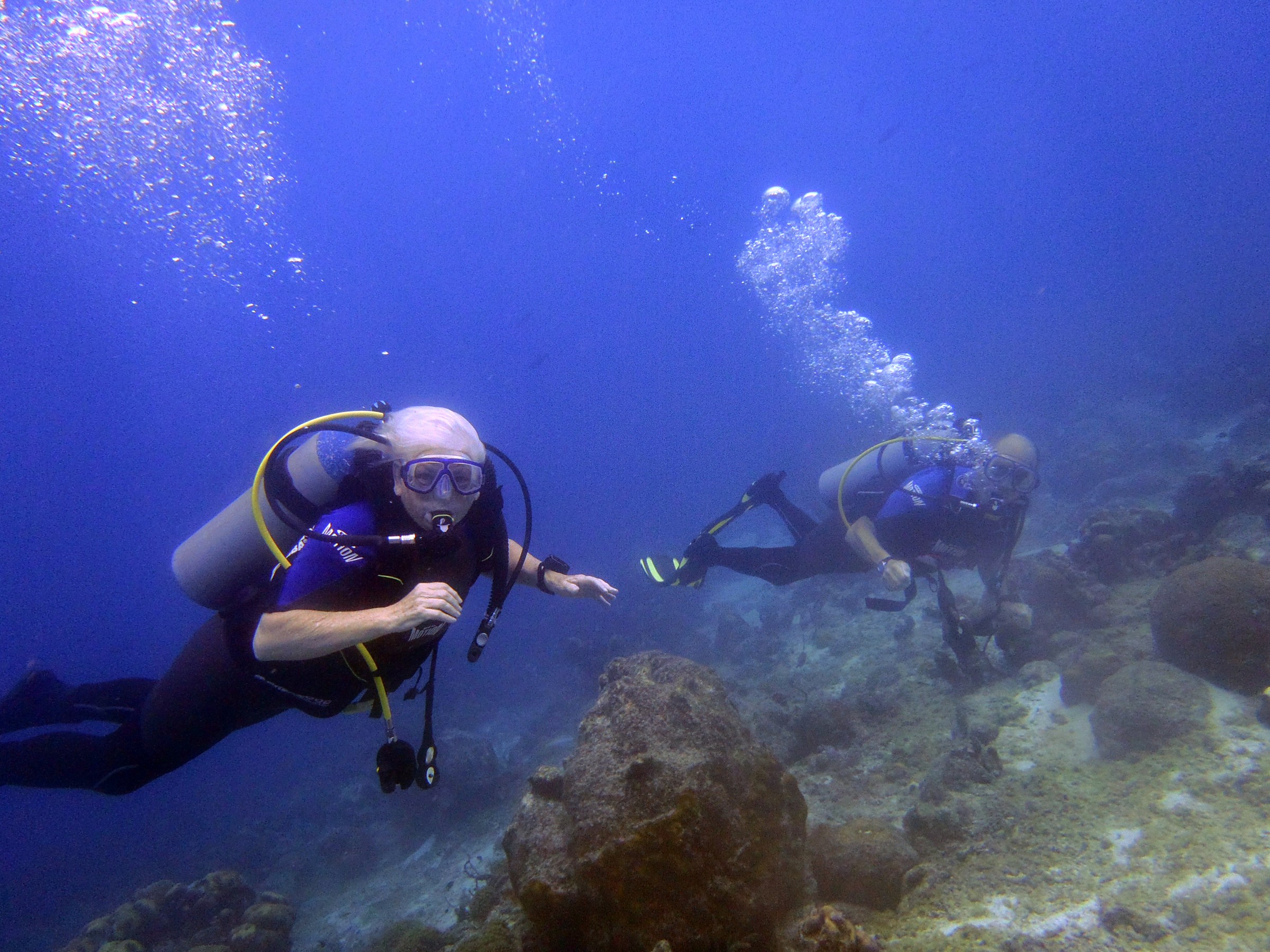
Hey, it’s been almost a month since I posted – sorry, it was such a great diving trip that my writing got kind of way-laid. Additionally, I picked up a viral computer bug that packed up my computer and I had to reformat the entire disk. Fortunately I had a back-up, but you know how long it takes to set everything up again if you have ever had this happen. I can’t believe the number of updates to the programs I am running since I first put my laptop into service in 2003. Now I will only use it for my off-line work and do my on-line work through the newer model. …Back to the dive trip.
My wife and I both took a Padi Diver Rescue course for the first six days that we were there in Curacao. An excellent thing to study. It certainly makes you aware of a lot of things that we all tend to get sloppy about after diving for a number of years such things as: predive plans, knowing the area, slow assent and even as important the slow descent when going do. Checking equipment BWRAF before you go in, use of non-resucitation oxygen systems and getting someone ashore and removing equipment….on and on, but it really improves the confidence in diving and doing it right.
If you are in search of a great diving site and place to stay, go to Waterside Apartments in Boca Sami, Curacao, Netherlands Antilles and take a look. Right on the water, we’ve been there over 12 times already in the past 10 years and are booked in again already for next year. Rudi and Tina are outstanding hosts!
We did 24 dives on this particular trip – all over the island, but about 2/3 in Snake Bay (Shlang Baii in Dutch) just in front of Waterside. The perfect place to see rays, turtles, scads of fish and wonderful corals. Other sites that are always our favorites – but not on weekends – are: Blue Bay – The Wall, Behind Electro-Curacao, Mari Pon Pon, Varsan Baii, Klein Knip, The tugboat – don’t miss swimming under the old piers at the end of the dive for big barracuda, West Point, Punta Mari, and Boca Sami Bay to name a few.
Equipment Rentals and Classes are easily found at nearby Wederfoort Dive and Blue Bay and Waterside has air tanks available at the regular price right at the Apartments so you just hang your gear in the locker and set up for dives in Snake Bay by walking in from the back door. Great! See you there!
Book Review: A Flaw in Forsyth’s “No Comebacks”
No Comebacks by Frederick Forsyth (4.5 – 5 Stars)
Forsyth is a master on the same level as Wilber Smith when it comes to being a raconteur of tales. In the same was a Smith, he picks an area of the word he knows best for this set of short stories an pulls the reader in from the first paragraph. Of the ten short stories, I actually have three favorites and a fourth that I loved although it has a slight flaw which may never have been pointed out in previous reviews.
First, a bit about my three favorites without giving away the stories:
“Comeback” which is the first in the compendium is by far the best, showing us the flaws in the reasoning behind the plan to set up a murder for hire. Well done, right down to the last lines that hit the reader far between the eyes.
“The Emperor “wins my second place vote in this series, mainly because of the description of the fight to bring in the fabulous Marlin. Here is descriptive writing at it’s very best, capturing the full imagination of the reader right down to Murgatroyd’s bloody hands and the throes of death displayed by the monster. The final stages brought tears to my eyes. Truly the mark of a fabulous writier!
“Used in Evidence” brings out again the Master Tale Teller in Forsyth. He had me hanging on the ending for the old man wondering what the final evidence would show, right up to the last line. Remember to count your chickens.
The final great story “There are no Snakes in Ireland” is a mastery of showing human relationships and how different cultures react and perceive the same bits of information. It is also a model for remembering that racism can build up angers and tensions that have a comeback on the perpetrator of a prank. The one flaw is actually only obvious to a snake handling biologist who might have used a bit of tobacco or pipe tar to kill a snake in a manner that leaves it totally relaxed. By the time our snake had been in Big Billie’s tobacco contaminated pocket for even a few minutes, it would have been long gone from nicotine poisoning. But my telling you this isn’t a spoiler, since that’s not the end of the story.
Enjoy the read. You’ll learn why not to blackmail some “little people” and you’ll laugh at the consequences of greed and philanthropy. A great book to tell your buddies about!
Who Says Religions Can’t Work Together! Mission 4/1 Earth
One of the really big myths being foisted off on us by media is that there can’t be any interreligious cooperation between groups like the Abraham origin religions including: Jewish, Christian and Muslim faith groups because they are so different.
Are they really so different? No, not when you get truly earnest mission oriented proects to save something like good old Mother Earth. The folowing groups are just a few of the religious groups working to make humanity aware of our need to protect, change life styles and work together to influence our governments to get off their behinds to focus on collectively stopping major pollution, greenhouse warming, and the cessation of exploitation of natural resources is fragile environments such as the Artic, S. China Sea, and Rain forests of Africa, S.American and S. E. Asia.
Here are a few of the movers and shakers in this worldwide movement. You can add more to the list simply by a bit of web searching. If you can’t find your religious group, be prepared to ask, “Why don’t we(that means your religious group) give a damn about the unsustainable condition that Humanity is putting our global spaceship in?” “Why don’t we care that we are drowning our earth in our own defecation?”
Look them up ! Read about them and become a part of mission for your Earth!
United Church of Christ’s “Mission 4/1 Earth”
The Jewish Climate change Campaign
Muslim Seven Year Action Plan on Climate Change
The Evangelical Climate Initiative
American Friends Service Committee (Quakers)
Jewish Climate Initiative
“Green Muslims”, Eco-Islam . . .
Peace! Rick McBee
South Africa Book Group on Goodreads
.gr_grid_container { /* customize grid container div here. eg: width: 500px; */ } .gr_grid_book_container { /* customize book cover container div here */ float: left; width: 39px; height: 60px; padding: 0px 0px; overflow: hidden; }
 1557 members
This is a book club for all South Africans who love reading! We also have members from other coun...
Books we've read


View this group on Goodreads »
Share book reviews and ratings with South African Book Lovers, and even join a book club on Goodreads.

